
Last updated September 10, 2026
Full 25-point door and opener safety check with every visit - springs, cables, rollers, tracks, and your LiftMaster or Chamberlain opener included
You get a price before we start. It does not change when the truck arrives.

 Before
 After
After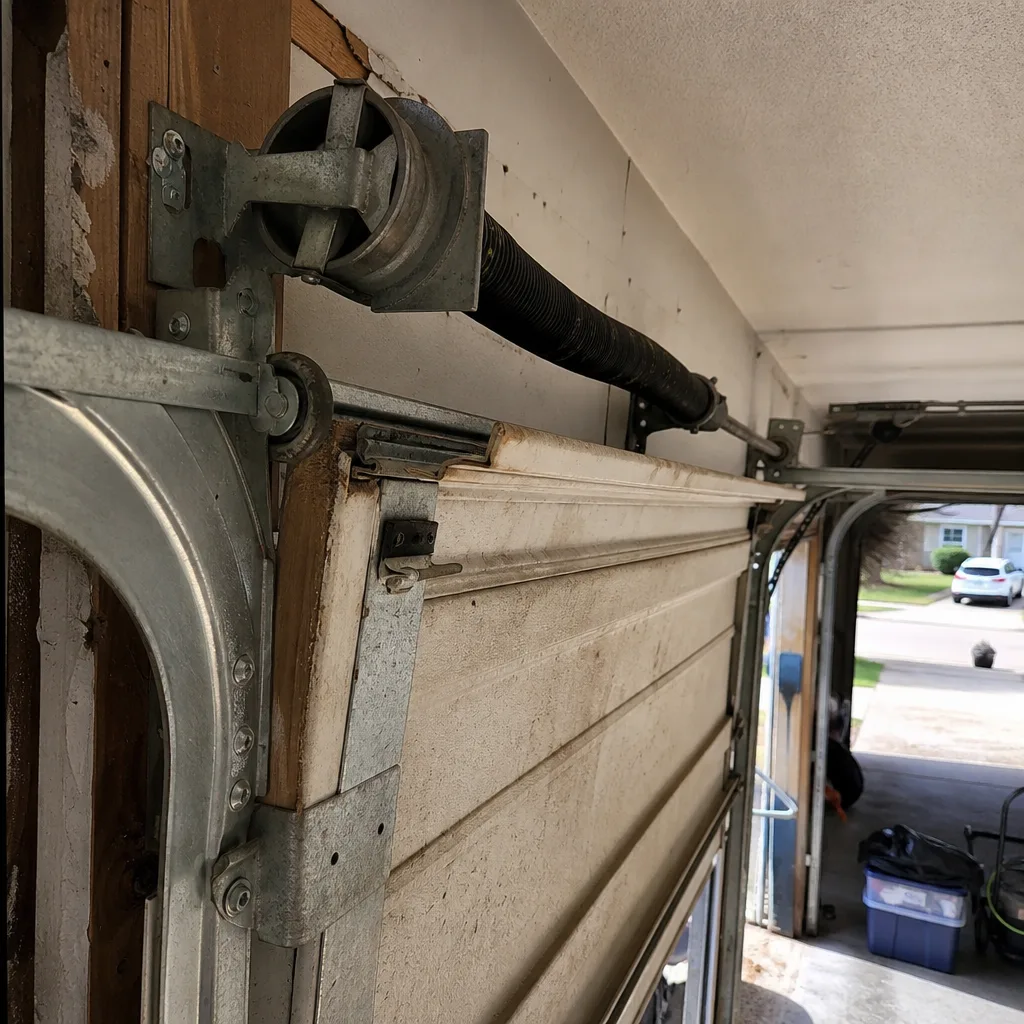 Before
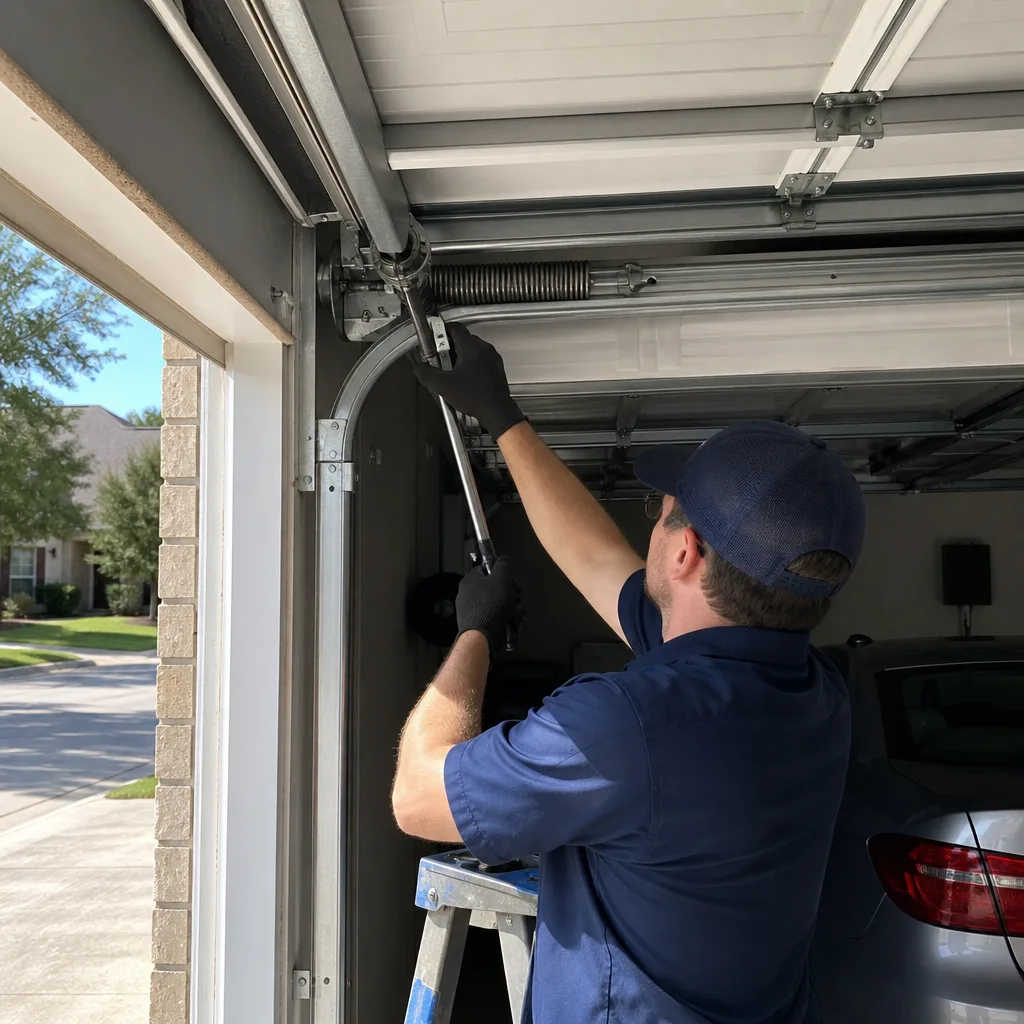 After
After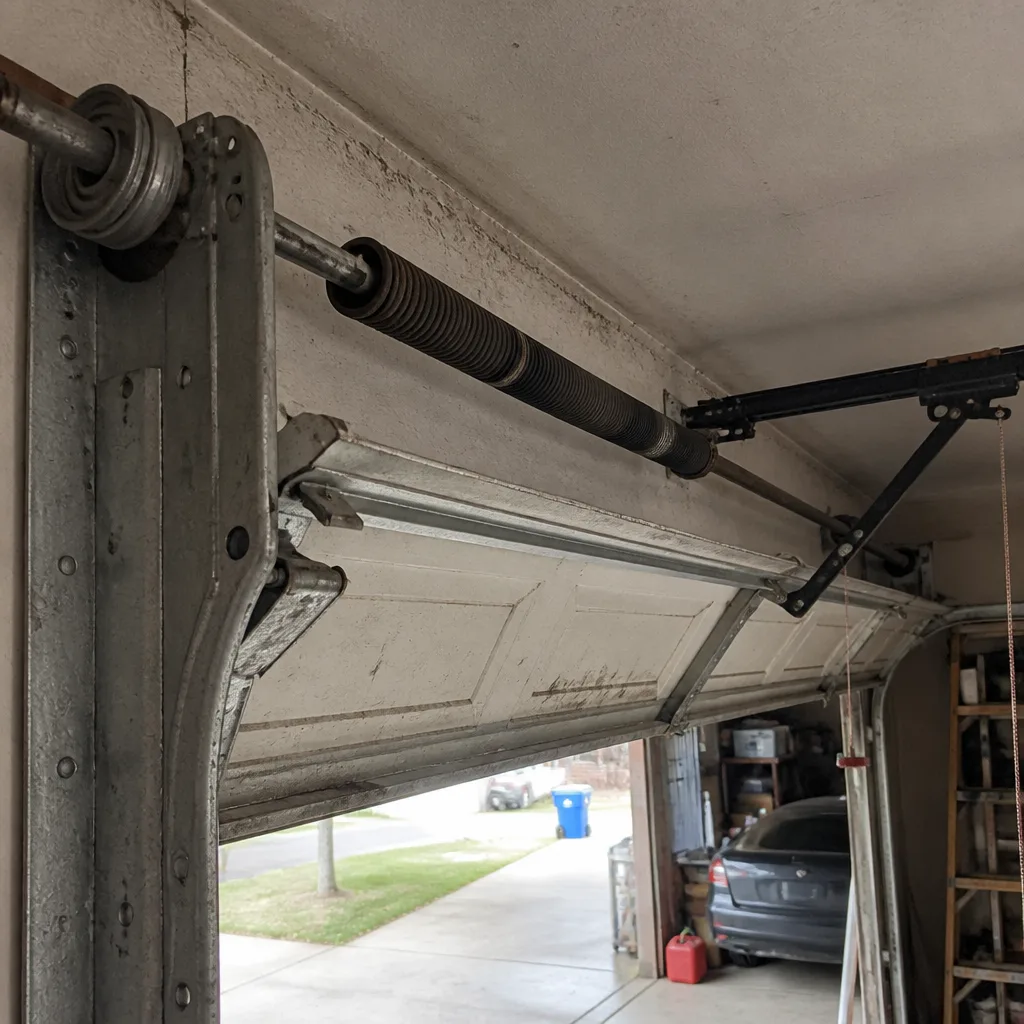 Before
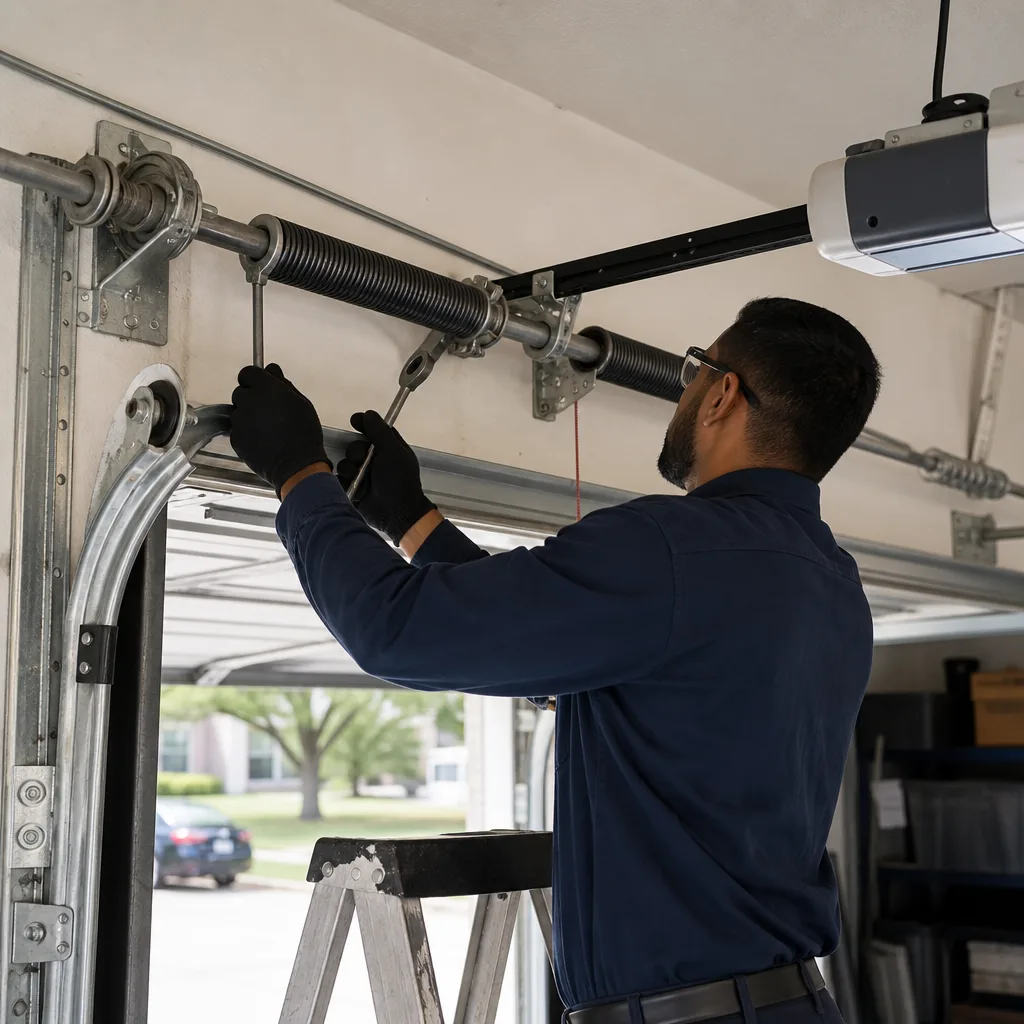 After
AfterGarage Door Repair Maintenance Checklist for Carrollton Homeowners
Ask anyone who has ever had a torsion spring let go in a Carrollton garage at 6:30 on a February morning, and they’ll tell you it didn’t feel sudden. It felt like the hundred little sounds they’d been ignoring for six months finally collected on the bill. The hinge that squealed since Labor Day. The door that shimmied just a little on the left track every time the kids left for school. In our two decades of our Garage Door Repair services across Carrollton, the doors that fail “out of nowhere” almost always gave warning. This checklist is what actually needs checking here, not what a manufacturer’s PDF says might matter somewhere else. We’re going to walk through the maintenance that keeps a Carrollton garage door running quiet and straight through North Texas heat, spring rains, and the fine construction grit that never quite leaves the air around new subdivisions. By the end, you’ll know what to check monthly, what to ignore, where the safety line is, and when a phone call beats a wrench.
Quick Answer
Garage door maintenance in Carrollton, Texas comes down to a seasonal rhythm built around our dust, humidity spikes, and thermal swings. Test your auto-reverse mechanism monthly by placing a roll of paper towels under the door, lubricate the hinges and rollers with a silicone spray every three to four months, visually inspect the torsion springs for gaps and rust every month, and schedule a professional tune-up once a year to check spring cycles, cable wear, and opener force settings. For more guides & resources, see our blog. Anything involving the springs, cables, or track bolts is a professional job, not a DIY one.
Table of Contents
- Monthly Maintenance Tasks for Carrollton Homeowners
- A Season-by-Season Maintenance Rhythm for Carrollton’s Climate
- The Three Lubrication Points Most Homeowners Skip
- Testing Your Auto-Reverse the Right Way
- What a Worn Torsion Spring Looks Like Before It Snaps
- DIY-Safe Tasks vs. Leave-It-to-a-Pro Tasks
- Common Mistakes to Avoid
- When to Call a Professional
- Frequently Asked Questions
- The Bottom Line
Monthly Maintenance Tasks for Carrollton Homeowners
A garage door moves more than any other mechanical system in your house, and in Carrollton it does that work while hauling the load of spring pollen, summer dust, and fall leaves into the tracks. Monthly checks don’t take long, and they’re the difference between catching a failing roller and replacing a snapped cable at 8 p.m. Here’s what we check every single time we’re in a Carrollton garage for a service call, and what you can check yourself in about ten minutes.
Start by opening the door fully, then closing it, and just watch. Listen for grinding, squealing, or a rhythmic thump that happens at the same point in every cycle. A thump that happens once per revolution almost always means a flat spot on a roller. A squeal that happens only when the door passes a certain point means a hinge is dry or binding. These sounds are the first clue that something’s wearing out, and they’re free to notice.
Next, look at the track on both sides. Carrollton’s dry weather means less rust than coastal Texas, but it also means more fine dust, the kind that settles on the track and gets pressed into the rollers. Run a rag along the inside of each track to clear it. If you see black gunk building up, that’s worn roller material mixing with dust, and it means the rollers are shedding. In the Castle Hills and Indian Creek neighborhoods we work in regularly, that fine construction dust from ongoing development makes this a monthly necessity, not a quarterly one.
Finally, check the door’s balance by hand. Disconnect the opener by pulling the red emergency release handle, then lift the door by hand to about waist height and let go. A balanced door stays put. If it drifts down, a spring is losing tension. If it slams down, a spring is failing. Neither is a DIY fix, but catching the drift early means you pay for a spring at the start of its decline, not for a spring plus a bent track after the door comes down hard.
While the door is disconnected, check the rollers themselves. Steel rollers on steel tracks wear faster in dust than nylon rollers, and Carrollton’s airborne grit accelerates the timeline. Look for wheels that don’t spin freely, that wobble when you push on them, or that have visible flat spots. Worn rollers put extra load on the opener and on the springs, which means you trade a $30 part for a $300 one if you wait.
Ten-Minute Monthly Walkthrough
- Run the door through one full open-close cycle and listen for new sounds.
- Wipe the inside of both tracks with a clean rag to clear dust and grit.
- Check for loose bolts on the track brackets and the hinges.
- Look at the cables on both sides for fraying or a loose wrap.
- Pull the red release handle and check the door’s balance at waist height.
- With the door still disconnected, run your hand across each roller and check for wobble or flat spots.
- Reconnect the opener and run the auto-reverse test described below.
This whole walkthrough takes about as long as brewing a pot of coffee, and it catches the problems that used to surprise people before they started doing it. We’d rather see you catch a dry hinge in March than call us for a broken spring in August. If you’re unsure about anything on this walkthrough, our Garage Door Repair in Carrollton page covers what a service visit includes, and we’re always happy to walk you through it over the phone.
A Season-by-Season Maintenance Rhythm for Carrollton’s Climate
Manufacturer checklists split maintenance into spring and fall, which makes sense in Ohio. Carrollton doesn’t have an Ohio calendar. We have a long hot dust season, a short wet season, and a few weeks of actual winter that arrives without warning and leaves just as fast. What keeps a door healthy in Carrollton follows that rhythm, not a calendar someone printed in Indiana.
Late winter (January through February). This is when we get the calls about frozen or sluggish openers. Cold contracts metal, and grease that was fine in October turns to stiff paste in January. The plastic gears inside openers get brittle in the cold, which is why opener failures spike on the first genuinely cold morning. Your job this season is simple: watch the door move slower than normal and call before the opener motor burns out fighting cold-thickened grease. A door moving sluggishly in January is a door that might not move at all in February. We also see condensation inside garages during cold snaps, especially in older homes around downtown Carrollton where garages aren’t climate-controlled. That condensation rusts hardware faster than rain does, so a quick wipe-down of visible metal parts after a cold snap helps.
Spring (March through May). Carrollton’s spring brings humidity spikes and the first serious pollen load. Pollen is sticky, and it mixes with the dust on your track to form a gum that binds rollers and clogs hinges. This is the season to do a thorough cleaning of the tracks and a full lubrication pass. It’s also the season when we see an uptick in sensor alignment problems, because spring storms shift the ground enough to knock the door frame a fraction of a degree out of square. A sensor that worked in December but blinks in April usually just needs a gentle realignment, but the fix is harder than I’m going to describe here, because the first lesson of garage doors is to respect what a 200-pound door can do if you’re standing in the wrong spot when it lets go.
Summer (June through September). This is the season that separates well-maintained doors from neglected ones in Carrollton. Sustained heat over 95 degrees softens rubber seals, bakes the lubricant off hinges, and stresses the torsion springs, which are already doing their hardest work lifting a door that’s swollen slightly from humidity. We count spring cycles during summer tune-ups more than any other season. A 10,000-cycle spring on a door that opens four times a day lasts about seven years. In Carrollton’s heat, that math gets a little less forgiving. If you’re not sure how many cycles your springs have on them, a summer tune-up tells you what’s left. The Garage Door Opener in Carrollton page goes into more detail on how heat affects opener electronics, but the short version is: heat kills capacitors, and capacitors are what make your opener work on a 100-degree afternoon.
Fall (October through November). Fall in Carrollton is the season for clearing leaves out of the track corners, but the bigger job is prepping for winter. The first cold front that drops overnight temperatures below 40 degrees separates the doors that were lubricated in September from the ones that will seize in December. This is also the season for checking weatherstripping along the bottom of the door. A dry, cracked bottom seal in October lets cold air and field mice into the garage by January. It’s a cheap replacement and a five-minute fix, and it’s the kind of thing we’re happy to handle during a tune-up rather than as an emergency call.
Year-round, for homes near new construction in Carrollton. If you live in a newer development, you know the dust never stops. Homes in the Hebron and Rosemeade corridors sit near active or recent construction, and the fine silt that comes off those sites is abrasive in a way regular dust isn’t. It works into hinges, rollers, and the chain on your opener, and it accelerates wear on everything it touches. If you live near active construction, cut all the recommended maintenance intervals in half. Monthly track cleaning becomes twice-monthly. Quarterly lubrication becomes every other month. It’s the single cheapest thing you can do to protect a door in a new Carrollton neighborhood.
The Three Lubrication Points Most Homeowners Skip
Almost everyone knows to spray the track. What they miss is that the track rarely needs lubrication at all, and the parts that do need it are the ones nobody looks at. Here are the three spots we find dry on nearly every Carrollton service call, and what they cost you when they stay dry.
The top hinge bearing on each side. The top hinge takes the most force when the door transitions from vertical to horizontal, which means it’s the first to dry out and the first to wear. A dry top hinge squeals at the top of the travel, but more importantly, it creates sideways play in the door as it rounds the curve. That play puts stress on the track bolts, and a track bolt that works loose turns a $15 hinge into a $400 track repair. When you lubricate hinges in Carrollton, hit the top pair first and do it thoroughly.
The torsion spring’s coils themselves. The springs sit above the door, and they need a light coat of lubricant along their entire length to prevent friction between coils as the spring winds and unwinds. That friction generates heat, and heat is what eventually kills a spring’s cycle life. We use a silicone or lithium spray, never WD-40, which is too thin and too penetrant, and never a heavy grease, which collects Carrollton dust like a magnet. Spray the spring coils every time you lubricate the hinges. If the spring already has visible rust, the rust has already started pitting the metal, and no lubricant will undo that. This is the visual check we teach in the next section.
The roller bearings themselves. Nylon rollers have bearings inside the wheel, and those bearings need a drop of oil where the wheel meets the stem. Most homeowners lubricate the track, which the door then slides on with more friction, not less. The bearings are what spin the wheel, and dry bearings mean the wheel skids instead of rolls, which flats out and sheds material into the track. On most Carrollton homes, roller bearings are dry enough by month three that a lubrication pass makes a noticeable difference in how quietly the door runs.
The right lubricant matters in Carrollton’s dust. We use a dry silicone spray for hinges and springs and a white lithium grease for the opener chain. The reason is the dust. Wet lubricants and penetrating oils collect airborne grit and turn into grinding paste. A dry silicone lubricates without leaving a sticky film, which is exactly what a dusty climate needs. If you’re using something you bought for your truck, you’re using the wrong thing. And whatever you do, don’t use grease on the track. The track is designed to run clean and dry. Greasing it is the fastest way to make a garage door louder in Carrollton than it already is.
Testing Your Auto-Reverse the Right Way
The auto-reverse feature is the single most important safety system on your garage door opener, and most homeowners test it wrong. The test that matters isn’t the one where the door pauses and reverses when it touches the obstruction. It’s the one where the door reverses before the opener’s pressure limit even registers the obstruction. Here’s how to test it correctly, and here’s what a failed test means.
Every opener manufactured since 1993 has two sensing systems. The first is the mechanical force limit, which detects when the motor is pushing against something and reverses the door. The second is the photoelectric sensor pair mounted about six inches off the floor on both sides of the door opening. Those sensors project an invisible beam, and when anything interrupts the beam, the door won’t close. Both systems can fail independently, and a door that passes one test can still fail the other dangerously.
The correct test is simple. Place a roll of paper towels flat on the floor directly beneath the door’s closing path. Close the door using the opener. The door should reverse and return to the fully open position before it crushes the roll. If the door crushes the roll and doesn’t reverse until the motor strains, the mechanical force limit is set too high. If the door crushes the roll and keeps going, the safety system has failed entirely, and that’s an immediate professional call. We also recommend the second test: with the door open, wave your hand in front of one of the sensors and press the close button. The door should refuse to close and the opener light should blink. This tests the photo sensor system independently.
In Carrollton, we see a pattern in which sensors fail after storms. The ground shifts, the door frame moves, and the two sensors go out of alignment by a fraction of a degree. The beam still fires, but it doesn’t hit the receiver, and the opener treats that as an obstruction. The door opens but won’t close, or closes only when you hold down the button. Homeowners try to fix this by taping the sensors together or aiming them at each other manually, which usually makes it worse. Sensor alignment takes about ten minutes with the right technique, but it requires understanding the mounting bracket, the aiming angle, and the opener’s indicator light. A garage door repair visit handles it properly. The Otto’s Garage Door home page has our contact information if you’re dealing with a blinking sensor and want someone to walk you through it before you spend money.
What a Worn Torsion Spring Looks Like Before It Snaps
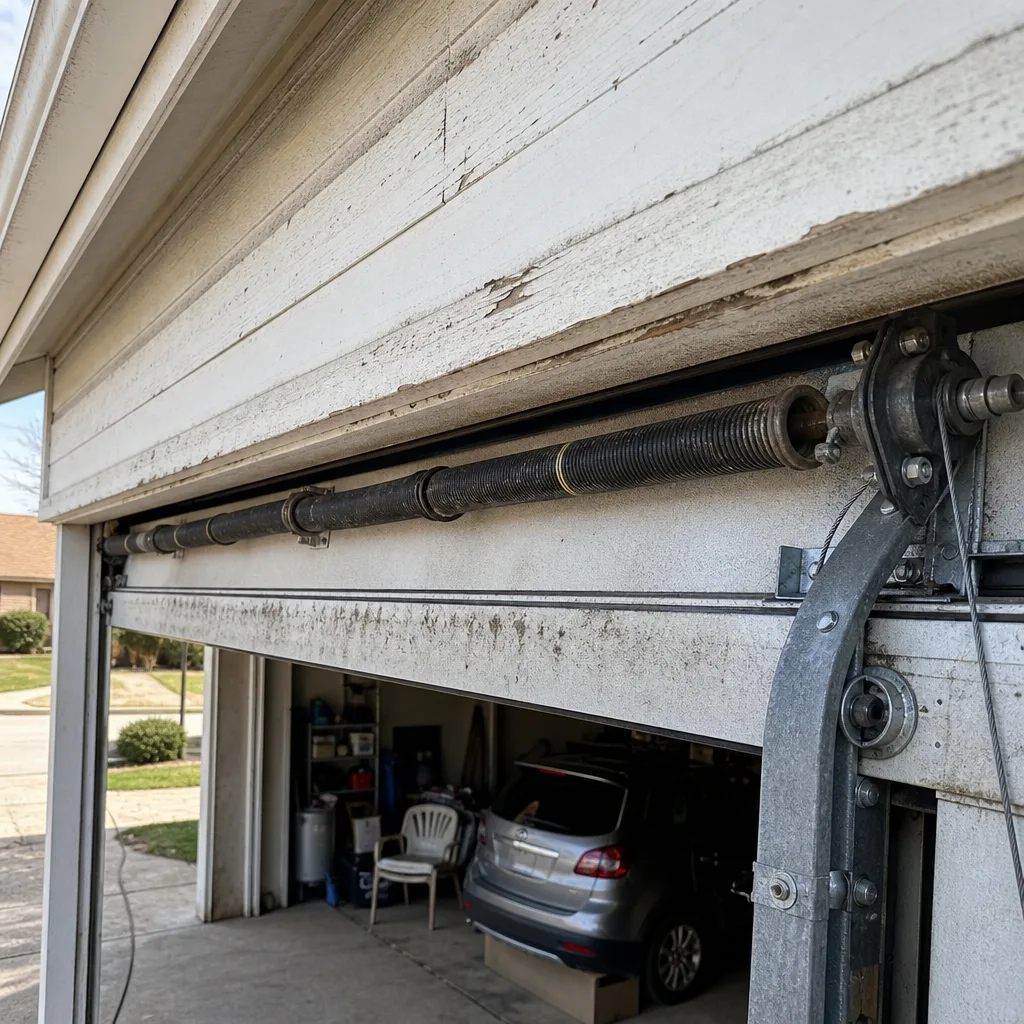
A torsion spring doesn’t fail silently. It gives visual warning for weeks or months before it breaks, and once you know what to look for, you’ll see it. For a deeper look, read our Garage Door Warning Signs: A Carrollton Homeowner’s Reference Guide. Here’s what we check on every spring inspection in Carrollton, and what separates a spring with two years left from one with two weeks.
Check for a gap in the coils. A healthy torsion spring is tightly wound with no visible gap between the coils. When a spring is nearing the end of its cycle life, the metal starts to fatigue, and the coil opens a crack. Look at the spring from a few feet away with a flashlight. If you can see daylight between any of the coils, that spring is telling you it’s nearly done. A quarter-inch gap means it’s lost structural integrity. A half-inch gap means it can snap at any time.
Look for rust pitting, not just surface rust. Surface rust on a spring in Texas is common, especially in uninsulated garages. Surface rust looks like a light orange film. Pitting looks like small craters or visible flakes in the metal. Pitting is where the rust has eaten into the steel, and that’s where the spring will break. If you see pitting, don’t touch the spring, don’t try to test it, and don’t open the door until a professional has looked at it. A pitted spring under tension is the most dangerous part of a garage door system.
Check that both springs look the same. Most Carrollton garage doors have two torsion springs, one on each side of the center bracket. They should look identical in length, coil count, and gap pattern. If one spring has visible gaps and the other doesn’t, the worn one is taking less than its share of the load, and the good one is doing more. That imbalance accelerates wear on the good spring and puts uneven stress on the door itself. We replace both springs together even when only one has failed, because they wear at the same rate and a mismatched pair just breaks again sooner.
Know your spring’s cycle life. Standard torsion springs are rated for 10,000 cycles. A cycle is one open and one close. Open and close your door four times a day, and that spring is done in about seven years. If your door was installed when the house was built and you’ve been there a decade, your springs are on borrowed time no matter what they look like. We count spring cycles the way you count tire miles, and we’ll tell you what’s left on yours. A spring with 1,000 cycles left looks different from one with 5,000 left, but that’s an experienced-eye call, not a homeowner one.
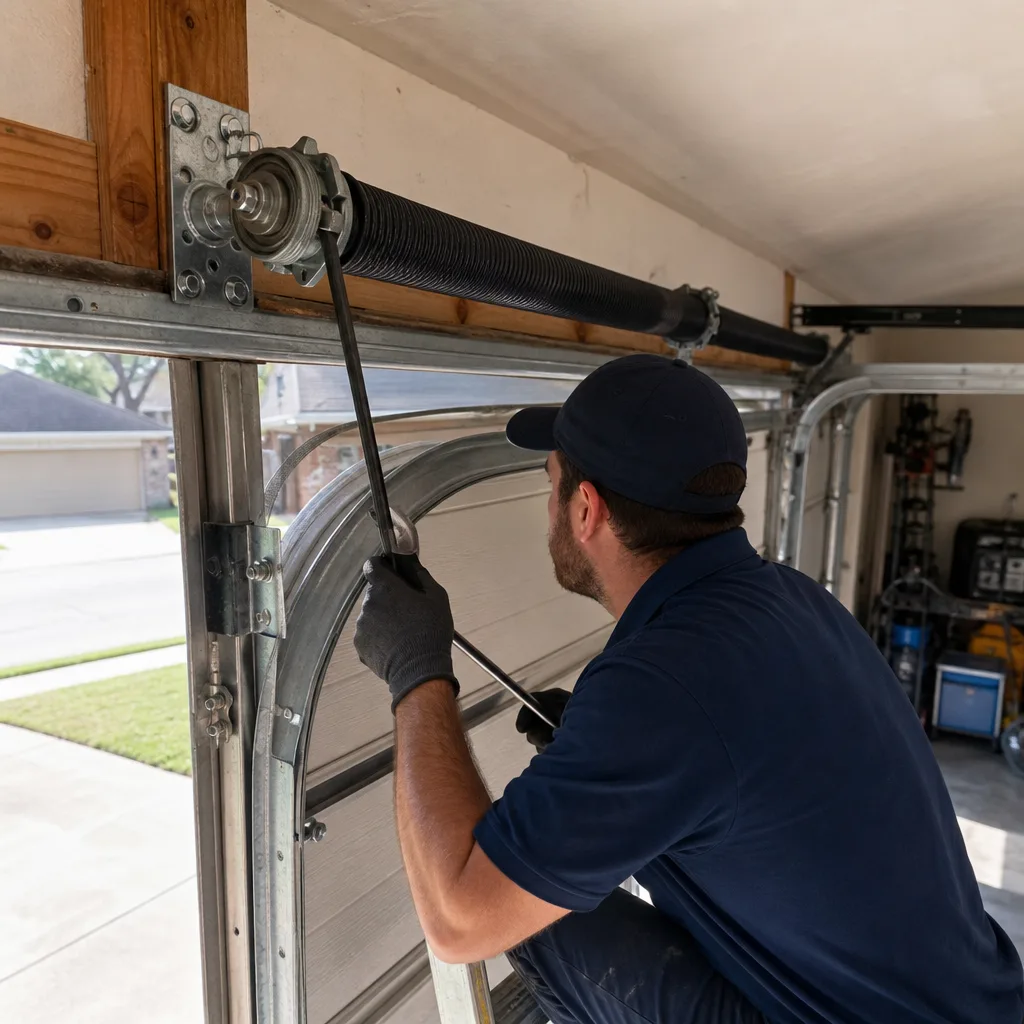
Safety first, always. Torsion springs hold 200 pounds of tension, and when they release that tension, they release it instantly. Never remove a spring, adjust a spring, or attempt to replace a spring yourself. The winding bar slips, the spring unravels, and the injury is permanent. This is not a matter of skill. It’s a matter of physics. Every Carrollton homeowner who respects that line stays safe. Every one who doesn’t ends up in an emergency room with a story they’d rather not tell.
DIY-Safe Tasks vs. Leave-It-to-a-Pro Tasks
There’s a clear line between what a Carrollton homeowner can safely maintain and what requires a trained professional. The line isn’t about skill. It’s about tension. A torsion spring under load has enough stored energy to break bone. Cables under that same load can cut. We’ve made this guide because we want you to do the safe maintenance yourself and call us for the dangerous parts. See also our How to Hire a Garage Door Contractor in Carrollton: A Step-by-Step Guide. Here’s the list, plainly drawn.
DIY-Safe Maintenance
- Visual inspection: Everything described above, from spring gaps to roller wobble, is safe to inspect visually. Just look. Don’t touch tensioned parts.
- Track cleaning: Wipe the inside of tracks with a dry cloth. No solvents needed.
- Lubrication: Silicone spray on hinges, spring coils, and roller bearings. This is safe and easy.
- Balance test: Disconnecting the opener with the release handle and testing door balance at waist height is safe if you keep your hands clear of the door edges.
- Weatherstrip replacement: Bottom seals slide out of the retainer and new ones slide in. No tools beyond a utility knife.
- Sensor cleaning: Wiping the photoelectric sensor lenses with a soft cloth clears dust that can cause false obstruction readings.
Professional-Only Work
- Anything involving torsion springs: Inspection is fine. Adjustment, winding, unwinding, or replacement is not. We carry the winding bars, the training, and the respect for what those springs can do.
- Cable repair or replacement: Cables run alongside the door and carry the spring’s tension from the bottom bracket to the top. A frayed cable under load is a loaded weapon.
- Track realignment or bolt tightening on the horizontal sections: The vertical track is stable. The horizontal track is under constant tension from the springs, and loosening the wrong bolt releases that tension into the nearest body part.
- Opener force setting adjustment: The force limit controls how hard the door pushes before reversing. Set it too high and the door crushes the next thing in its path. This is a professional adjustment.
- Spring cycle replacement: Springs are always replaced in pairs by a professional. We’ll tell you how many cycles your springs had left and install a matched set rated for Carrollton’s heat and dust load.
If you’re ever unsure which side of the line a task falls on, the answer costs nothing. Call us and describe what you’re seeing. We’ll tell you honestly whether it’s a ten-minute DIY job or a service call. That’s how we’ve done business in Carrollton since 2004, and it’s how Otto Reinhardt, the name on the van and the license, keeps his neighbors safe.
Common Mistakes to Avoid
- Lubricating the track. The most common maintenance error we see in Carrollton garages, and it’s counterproductive. Greasy tracks collect dust and make the door louder and harder to move. The track is meant to run dry.
- Using WD-40 on springs and hinges. WD-40 is a penetrant and water displacer, not a lubricant. It cleans and then evaporates, leaving metal dry and exposed. Use a silicone or lithium spray instead.
- Testing auto-reverse with a brick. A brick is too hard to compress, so the door’s mechanical force sensor triggers on the brick even when it wouldn’t trigger on a child or pet. Use a roll of paper towels, which compresses the way a body would.
- Ignoring a squeal because “it still works.” The squeal is dry metal on dry metal. It’s converting friction into heat and wear, and it won’t stop until the part is lubricated or the part fails. In Carrollton’s dust, a dry hinge goes from squeal to snap faster than most people expect.
- Replacing one spring at a time. Springs wear as a pair. Replace one, and the other fails shortly after, and now you’ve paid twice for the same job. We replace both as a matched set every time.
- Disconnecting the opener while the door is up. The red release handle should only be used when the door is fully closed. If you pull it while the door is open and the spring has failed, the door comes down like a guillotine. Always close the door first.
- Ignoring the weatherstrip until winter. A cracked bottom seal lets heat, cold, dust, and pests into your garage all year. Replacing it in October when the seal first cracks is a five-minute fix. Replacing it in January after the third cold snap means your garage has been heating the neighborhood for months.
When to Call a Professional
Call a professional the moment you see a gap in a torsion spring, a frayed cable, a door that slams down during a balance test, or a sensor system that fails both the roll-of-paper-towels test and the wave test. These are not escalation steps. They’re the point where the line is crossed. In Carrollton, a door with a broken spring is also a security problem, because a garage that won’t open doesn’t protect what’s inside it, and a garage that’s forced open with a bent track is a bigger repair than the spring would have been. If you’re not sure, call. Otto’s Garage Door offers free estimates in Carrollton, and we’ll tell you honestly whether you need a service visit or just a $6 can of silicone spray. We’ve been answering that question honestly since 2004. Call (945) 445-8489.
Frequently Asked Questions
Lubricate hinges, spring coils, and roller bearings every three to four months in most Carrollton neighborhoods, and every other month if you live near active construction where dust load is higher. Use a dry silicone spray, never WD-40 or grease, and never lubricate the track itself, which is designed to run clean and dry. If your door starts squealing between lubrication passes, don’t wait, lubricate immediately, because a dry hinge in Carrollton’s dust can wear past saving faster than people expect. Call (945) 445-8489 if you’re unsure what product to use.
A basic tune-up visit in Carrollton typically runs $89 to $150 depending on the door and opener, and that covers spring inspection, cable check, sensor alignment, lubrication, and balance testing. Repair costs vary widely by what’s worn, which is why we quote before the work begins and hold the price when Otto gets there. We offer a free estimate and a free second opinion on any written estimate, so you can compare without risk. Call (945) 445-8489 and we’ll give you an honest number on the phone.
No, and for reasons that are not about skill. Torsion springs hold 200 pounds of tension, and the winding bars that adjust them can slip and release that energy into the person holding them. This is the leading cause of serious garage-related injury in Texas, and no amount of YouTube preparation changes the physics. We replace springs in pairs as a professional job, and we’ll tell you on the phone what your spring inspection showed and what the replacement costs before we start. Call (945) 445-8489.
A garage door that opens on its own usually has a failing logic board in the opener, a stuck button on a wall console or remote, or interference from a neighbor’s opener on the same frequency. In Carrollton, where homes are close together and many openers are older models without rolling code security, frequency interference is more common than most people think. Start by checking all remotes and the wall console for stuck buttons, remove any remote from a car that’s parked in the sun, and call us if it continues. This is a free-estimate call, not an email tag. Reach us at (945) 445-8489.
Standard torsion springs are rated for 10,000 open-close cycles, which means about seven years for the average Carrollton family that opens the door four times a day. Texas heat and humidity can shorten that by a year or more, because heat accelerates metal fatigue and humidity causes rust that weakens the coils. If your springs are older than seven years, or if you see a visible gap in the coils, don’t wait for the snap. Call us and we’ll give you an honest read on what’s left. The number is (945) 445-8489.
Our trucks are stocked with the springs, cables, rollers, hinges, and opener parts we most commonly need in Carrollton’s housing stock, so most repair jobs are completed in one visit. If your door needs a part we don’t have on board, we’ll tell you before we start and give you a written estimate. The price never changes between the phone and the driveway. Call (945) 445-8489 for a free estimate.
The Bottom Line
A garage door in Carrollton runs through dust, heat, humidity, and the occasional hard freeze, and the maintenance that keeps it running is not complicated. Watch the door every month. Listen to what it tells you. Lubricate the three spots that actually need it. Test the auto-reverse with a paper towel roll, not a brick. Look for gaps in your torsion springs, and treat a visible gap as the countdown it is. Do the safe maintenance yourself. Call a professional the second the work crosses the tension line, because that line is absolute and the cost of crossing it is permanent. We’ve helped Carrollton homeowners keep their doors running since 2004, and we’d rather help you with a $6 can of silicone spray than a $400 spring and track repair. If you’d like a free maintenance assessment or want to schedule a tune-up, call (945) 445-8489. The person on the phone is the same person who will show up at your door, and he’ll hold the price he quotes.
Written by Otto Reinhardt, Owner at Otto’s Garage Door, serving Carrollton since 2004.